

Adoption Therapist for Birth Parents in NYC: Why Your Story Deserves a Specialist

If you’ve landed on this page, I want to start by saying: I see you.
Whether your adoption placement happened thirty years ago in a quiet corner of Upstate NY or three months ago in the middle of the NYC hustle, the emotions that follow aren't something you "just get over." You might have been told you were being "selfless," "brave," or even "heroic," but those labels often feel like heavy armor you never asked to wear. Inside, it might feel more like a confusing mix of grief, relief, guilt, and a million "what ifs."
First off, you're human. What you’re feeling: whatever version of it is showing up today: is a natural response to a life-altering event. You aren’t failing at "moving on" because healing from relinquishment isn't about moving on; it’s about moving through.
But here’s the thing: when you decide to talk to someone about it, you shouldn't have to spend the first four sessions explaining why adoption is complicated. You shouldn't have to educate your therapist on what "ambiguous loss" feels like. You deserve someone who already speaks the language.
Why a Generalist Isn't Always the Right Fit
New York is full of therapists. You can find a therapist in NYC for basically anything: from "my boss is a nightmare" to "I have a weird phobia of the G train." But when it comes to the specific, layered experience of being a birth parent, a general practitioner might accidentally miss the mark.
They might try to treat your experience as "standard" grief. But adoption grief is different. It’s "disenfranchised grief": a type of loss that society doesn't always give you permission to mourn openly. If a therapist doesn't understand the "adoption lens," they might focus on the wrong things, leaving you feeling more misunderstood than when you walked in (or logged on).
As an adoption therapist in NYC, I look at things differently. I’m C.A.S.E. (Center for Adoption Support and Education) certified, which is basically a fancy way of saying I’ve done the deep-dive training to understand the lifelong psychological impact of adoption on everyone involved.

Birth Fathers: You Belong in This Conversation, Too
Let’s address the elephant in the room: most resources for birth parents are heavily geared toward birth mothers. While the physical and emotional experience of a birth mother is unique, birth fathers are often the "ghosts" of the adoption story.
If you’re a birth father, you might feel like you don’t have a "right" to struggle because you weren't the one who carried the pregnancy. Or maybe you felt pushed out of the decision-making process entirely. Society often expects men to just "tough it out," but those feelings don't just disappear. The feelings show up in your relationships, your work, and your internal sense of peace.
In my practice, birth fathers aren't an afterthought. Your grief is valid. Your perspective matters. Whether you’re navigating an open adoption or dealing with the silence of a closed one, you deserve a space where you don't have to apologize for having feelings about your child.
The "Dig Deep" Difference
I’m not a "smile and nod" kind of therapist. If you’re looking for someone to just say "that sounds hard" for 45 minutes, I might not be your person. My style is collaborative and proactive. We’re going to dig deep.
In our sessions, we might explore:
The Narrative: What story have you been telling yourself about the adoption? Is it actually true, or is it a story built on shame?
The Triggers: Why does a certain commercial, a specific holiday, or even a walk through Central Park suddenly send you into a tailspin?
The Identity: Who are you outside of being a "birth parent"? How do we integrate this part of your history without letting it define your entire future?
The Nervous System: Adoption-related trauma lives in the body. We work on techniques to help your nervous system feel safe again, especially when the "what ifs" start screaming.
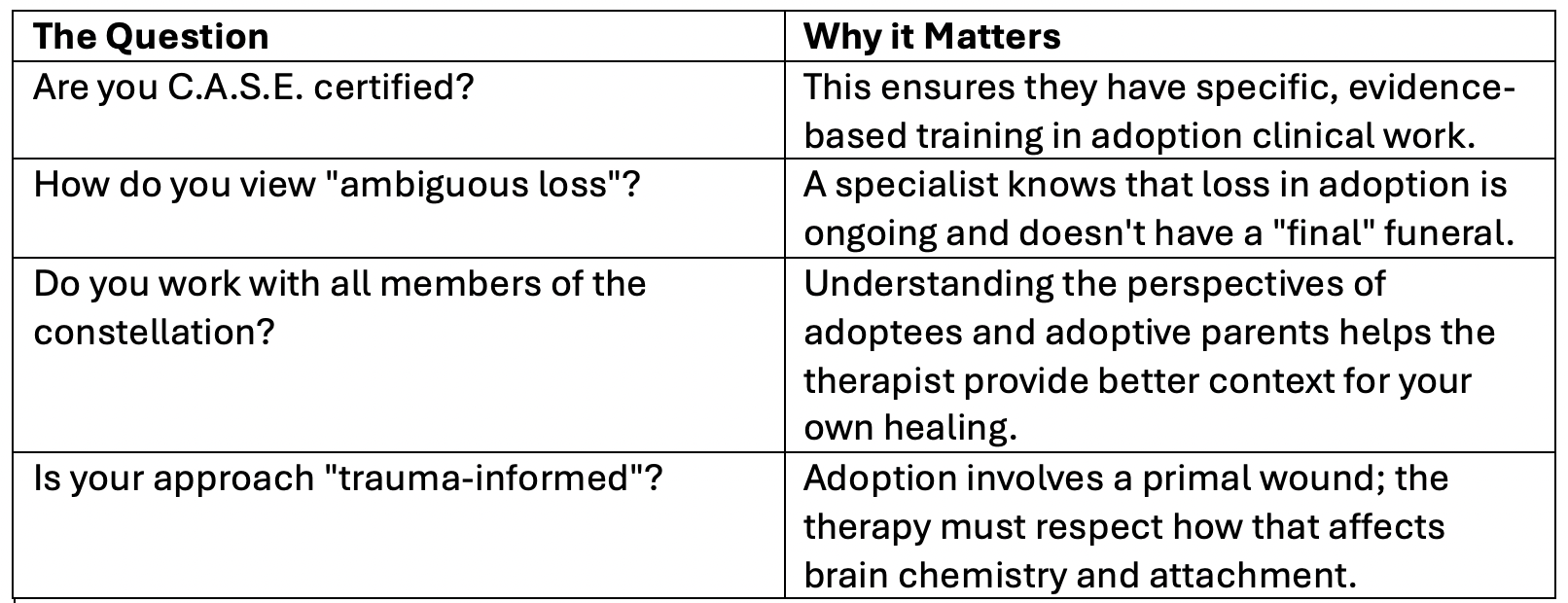
Is Your Therapist "Adoption-Competent"? (A Quick Checklist)
If you’re searching for an adoption therapist for birth parents in NY, here are a few questions to ask (or look for on their website) to make sure they actually get it:

Why NYC & New York Birth Parents Choose Online Therapy
Living in New York means you’re busy. Whether you’re balancing a career in Manhattan or raising a family in Westchester, finding time to commute to an office can feel like one more chore on an already overflowing plate.
That’s why I offer online therapy across NY, CT, and FL. You can process the hardest parts of your story from the safety of your own couch, with your own dog by your side and your own favorite tea in hand. There’s something incredibly powerful about doing this deep work in the place where you actually live your life. It makes the healing feel more integrated and less like something that only happens in a sterile office.
You Aren't Broken; You're Processing
One of the biggest hurdles birth parents face is the feeling that they are "flawed" for still feeling pain years later. I want to gently remind you: This isn't a flaw; it's a natural response. You made a massive, life-altering decision, often under immense pressure or during a time of crisis. Your brain and heart are just doing the work of trying to make sense of it all.
You don't have to carry the weight of "being strong" anymore. In our work together, we create a space where you can finally put the armor down. We look at the grief, we acknowledge the love, and we figure out how to weave it all into a life that feels authentic and whole.

Common Questions About Birth Parent Therapy
"Will therapy make me regret my decision?"
Therapy isn't about changing the past or forcing a specific feeling. It’s about giving you the tools to handle the feelings you already have. If regret is there, we look at it with compassion, not judgment. If peace is there, we strengthen it.
"I haven't thought about the adoption in years. Why is it bothering me now?"
Life transitions: getting married, having another child, losing a parent, or even just hitting a milestone birthday: often "unearth" adoption-related emotions. It’s very common for these feelings to resurface during big shifts.
"Can you help me navigate contact with the adoptive family?"
Absolutely. Boundaries in open adoption can be tricky. We can work on communication strategies that protect your emotional well-being while honoring the connection you want to have.
I Invite You to Reach Out
Healing doesn't happen in isolation. If you’re tired of carrying your story alone, or if you’ve realized that general therapy just isn't hitting the core of what you're experiencing, I’m here to help.
Whether you’re in the heart of NYC or anywhere across New York state, we can start this process together. You’ve spent a long time looking out for everyone else’s needs: the child’s, the adoptive parents’, your family’s. It’s time someone looked out for yours.
I invite you to reach out and schedule a session. Let's dig deep, find some clarity, and start building a path forward that feels like home.
About the Author
Gayle Weill, LCSW is a licensed psychotherapist specializing in maternal mental health, adoption competency, and adult autism evaluations. She provides virtual therapy to women and mothers in NYC. Through her clinical work, writing, and educational resources, she helps moms of sensitive children regulate their own nervous systems so they can respond with clarity rather than overwhelm.
